Successful implantology starts long before an implant is actually placed. Dental implant planning is the process through which the dental team evaluates the patient’s oral health, available bone, anatomy and restorative needs to determine how implant treatment should be approached.
At Alnoor Medical Center in Ras Al Khaimah, implant treatment can involve different surgical techniques and digital technologies depending on the individual clinical situation. Understanding some of the terminology used during planning can also make the treatment journey much clearer for patients.
Why is dental implant planning so important?
A dental implant is designed to replace the root of a missing tooth and provide support for a future restoration. However, simply having a missing tooth does not automatically mean that an implant can be placed in the same way for every patient.
Before dental implant surgery, the clinician needs to evaluate the condition of the gums, the available bone, the position of nearby anatomical structures and the type of final restoration required. Bite forces and the number of missing teeth can also influence the treatment plan.
This initial assessment helps determine not only where an implant may be positioned, but also whether additional procedures could be required.
How is the jawbone assessed before dental implants?
Bone is one of the key factors in implant treatment because the implant needs adequate support within the jaw. A CBCT scan for dental implants can provide three-dimensional information about bone dimensions and important anatomical structures.
If the available bone is insufficient, procedures such as a bone graft for dental implants or dental bone regeneration may be considered. In the posterior upper jaw, reduced bone height beneath the maxillary sinus may sometimes make a sinus lift necessary.
These procedures are not required for every patient. Their indication depends on individual anatomy and the position in which the implant needs to be placed.
What role does digital technology play?
Modern implantology can use digital information to plan treatment before surgery. With computer-guided implant surgery, three-dimensional diagnostic data can help the clinician evaluate the proposed implant position, angle and relationship with surrounding structures.
In selected cases, a surgical guide for dental implants can then help transfer aspects of this digital plan to the mouth during surgery. Some patients may also be suitable for flapless implant surgery, which uses a more limited surgical access without raising a conventional extensive gum flap.
Digital technology supports planning and precision, but it does not replace clinical judgement. The final approach must always reflect the patient’s actual anatomy and clinical conditions.
Can patients receive teeth immediately?
Another important part of dental implant planning is deciding when a restoration can be connected. Primary implant stability describes the mechanical stability of an implant immediately after placement and is one of the factors considered when evaluating certain faster treatment protocols.
In suitable cases, immediate loading dental implants may allow a temporary restoration to be connected shortly after implant placement. This concept is also associated with what patients commonly call same-day dental implants.
However, receiving a temporary restoration quickly does not mean that healing has already finished. Osseointegration, the biological process through which bone establishes a stable connection with the implant surface, still needs to take place over time.
What changes when several or all teeth are missing?
Implant planning is different when the objective is to replace an entire dental arch rather than a single tooth. Full-arch dental implants use multiple implants to support a complete prosthetic restoration instead of replacing every missing tooth individually.
Depending on anatomy and clinical requirements, treatment concepts such as All-on-4 dental implants or All-on-6 dental implants may be considered. For patients missing several teeth rather than an entire arch, an implant-supported bridge may provide another possible restorative approach.
The appropriate number and position of implants cannot be decided from a standard formula alone. Bone availability, bite, prosthetic design and the patient’s overall oral condition all need to be considered together.
What happens after the implant has healed?
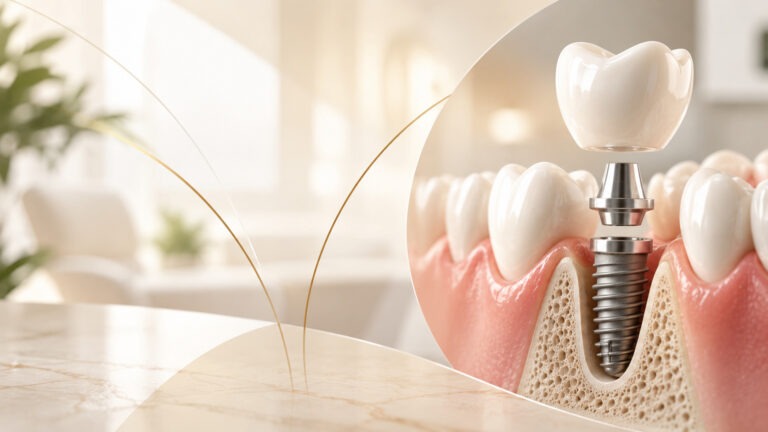
The implant itself is only one component of the final restoration. Once the clinical conditions allow the restorative phase to proceed, a dental implant abutment can provide the connection between the implant and the visible prosthetic restoration.
For a single missing tooth, this restoration may be a dental implant crown, designed to reproduce the visible part of the tooth and work correctly within the patient’s bite.
Healing remains an important part of this process. At Alnoor Medical Center, photobiomodulation after dental implants may be incorporated into selected treatment protocols as an adjunct to support the healing process following implant placement.
Dental implant planning in Ras Al Khaimah
Implantology includes much more than placing an implant into the jaw. Bone conditions, digital diagnostics, surgical technique, healing and the design of the final restoration all influence how treatment is planned.
For patients considering implant treatment in Ras Al Khaimah, understanding terms such as osseointegration, bone graft for dental implants, computer-guided implant surgery, immediate loading dental implants and full-arch dental implants can make conversations with the dental team easier to follow.
At Alnoor Medical Center, implant treatment is planned according to the individual clinical situation, combining diagnostic assessment, surgical planning and restorative considerations to develop an appropriate treatment pathway.
📞 +971 72288451
💬 +971 72288451
✉️ info@alnoordental.com
📍 8th Floor, Al Naeem Tower 3, Etisalat Street, Ras Al Khaimah, United Arab Emirates